 |
Comité Surveillance OTAN
|
|
Comité Surveillance OTAN
|
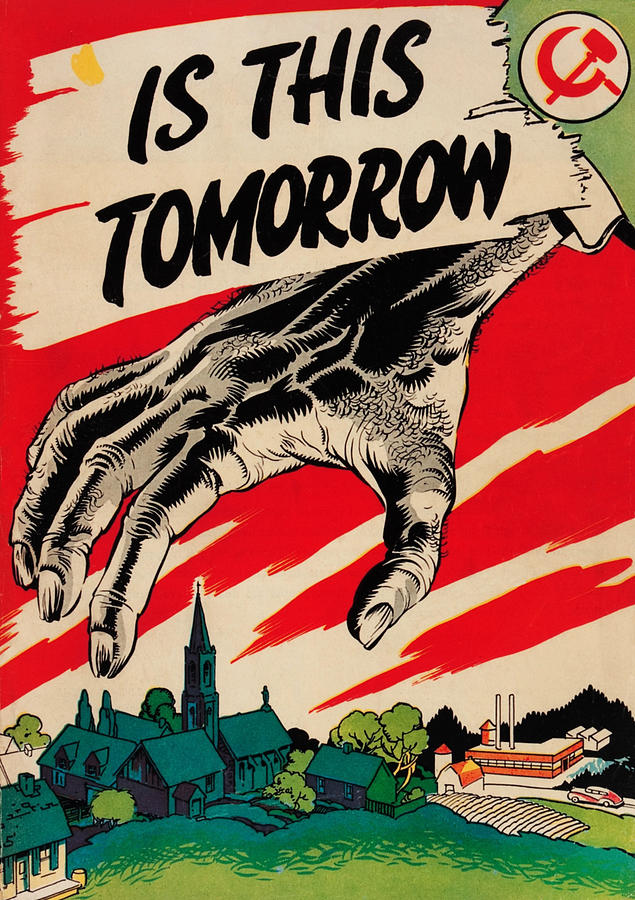
The latest refrain from the Atlanticist chorus: the tanks are on our doorstep! Anyone with a good memory knows what they're talking about. It's as old as the hills.
You'd have to be deaf as a corpse not to have heard the melody. We've heard it stammered cheekily by the President of the French Republic. And trumpeted by the NATO megaphones. And repeated in chorus by the print and broadcast media. Everywhere, the same refrain: Russian tanks are on our doorstep! And the message: from arid Lapland to sparkling Asturias, from the brave little Belgian coast to the ancient foothills of the Alps, we must prepare for war. All of Europe, as one.
It may make you smile. A little worrying, too. And for music lovers, it can give the impression of déjà vu.
The Red's fear is not just folkloric. It has the allure of incontinent continuity. Since the birth of the Soviet workers' state, scarcely a year has gone by without the Western ruling classes seeking, in word and deed, to wipe the intolerable off the map, namely that, over there, said ruling classes have been reduced to nothing.
The end of the USSR was not the end. The new Russia didn't play along. It refused to play the role of enclave in the world order desired by Washington. Nor has it embraced the ambiguous "values" that the European Union brandishes as its normative banner.
Through deeds and words, then. Among the latter: the scarecrow of a Russian invasion of Europe. Russian tanks! Ready to rush us!
We find the beginnings of this in Churchill's 1946 speech after the Second World War, now known as the Iron Curtain Speech1. While he dismissed the idea of a Russia ready for war, he shed copious crocodile tears over the countries, "from the Baltic to the Adriatic", trapped in the "Soviet sphere", without of course saying a word about the fact that he and Stalin were the architects of it.2 And he pointed to the USSR's "expansionist tendencies", particularly in the form of "communist fifth columns".
General de Gaulle soon followed suit. In his Appel au Rassemblement sur la France, February 1950, the Communist "sphere", enlarged by Red China, he said, "looms large before us", and from a still considerable tank distance: France "finds itself in immediate contact with this mass, whose western frontier is three hours' drive from the Rhine, and whose southeastern frontier borders our Tonkin posts."3 Tremble, citizens!
Should we add to the list Paul-Henri Spaak, "one of the most nefarious figures in contemporary Belgian history", as Marcel Liebman puts it? Let's just say that his so-called "speech of fear" at the United Nations in 1948 was right up there with the times. Addressing the Soviet delegation: "Do you know what the basis of our policy is? It is fear. Fear of you, fear of your government, fear of your policies”.
There will be a climax with the hit that had its moment of glory in France in the seventies and eighties. Launched in 1974 during the presidential election between Mitterrand and d'Estaing, and repeated in 1981 against the former, it featured a bass drum and the sound of boots: "If the Left wins, we'll see Soviet tanks on the Place de la Concorde"4.
And yet, the historical fact is as undisputed as it is little publicized: Moscow has never dreamed of extending its borders beyond Russia, neither in Soviet times, nor today, under Putin.
The ditty, however, has not aged a bit. Whether in Washington, Brussels or NATO, it is as deafening as the worst Eurovision turnips. And salaried "experts" get on the bandwagon. François Reynaert, historian: "For Putin, Russia's borders stop nowhere" (19/11/23); Jean-Maurice Ripert, ambassador: "Putin will stop at nothing to pursue Russian neo-colonial expansionism" (29/2/24); Dominique Moïsi, consultant, Institut Montaigne: "Vladimir Putin, on the road to a new Russian imperialism?" (7/2/22). Etc. On the Web, you're spoilt for choice.
What's so pleasing about this brainwashing is that it's all too apparent. It's all too apparent.
1. Original text: https://www.nationalchurchillmuseum.org/sinews-of-peace-iron-curtain-speech.htm
2. He is more frank in his wartime writings, where in October 1944, in Moscow, he recounts how he and Stalin divided up their respective "spheres" on a small piece of paper - The Second World War (abridged), 1959, pp. 852-854.
3. https://fresques.ina.fr/de-gaulle/
4. See: "But by the way, where did this image of the ''''Russian tanks on the Place de la Concorde'''' come from?", Jean-Marie Pottier, 13 april 2017, https://www.slate.fr/story/143585/chars-russes-concorde